
 Media & publishing
92% accuracy in 3 days: how LabelFort structured 19,865 app reviews at scale
How LabelFort transformed 19,865 unstructured customer reviews into 59,595 structured labels - Sentiment, Rating, and multi-label Topic Tagging - using an AI-first single-pass workflow with QA validation.
- E-commerce & consumer
- Text · sentiment, rating & topic tagging
Contents
The client builds feedback intelligence and customer experience analytics systems that turn unstructured review text into actionable training data. Their models depend on three outputs per review - Sentiment, Rating, and Topic Tagging - so mixed-tone reviews and multi-issue complaints are captured accurately rather than flattened to a single label.
LabelFort processed 19,865 customer reviews and produced 59,595 structured labels within 3 days, using a single-pass AI workflow with structured QA validation across 34 annotators.
The challenge
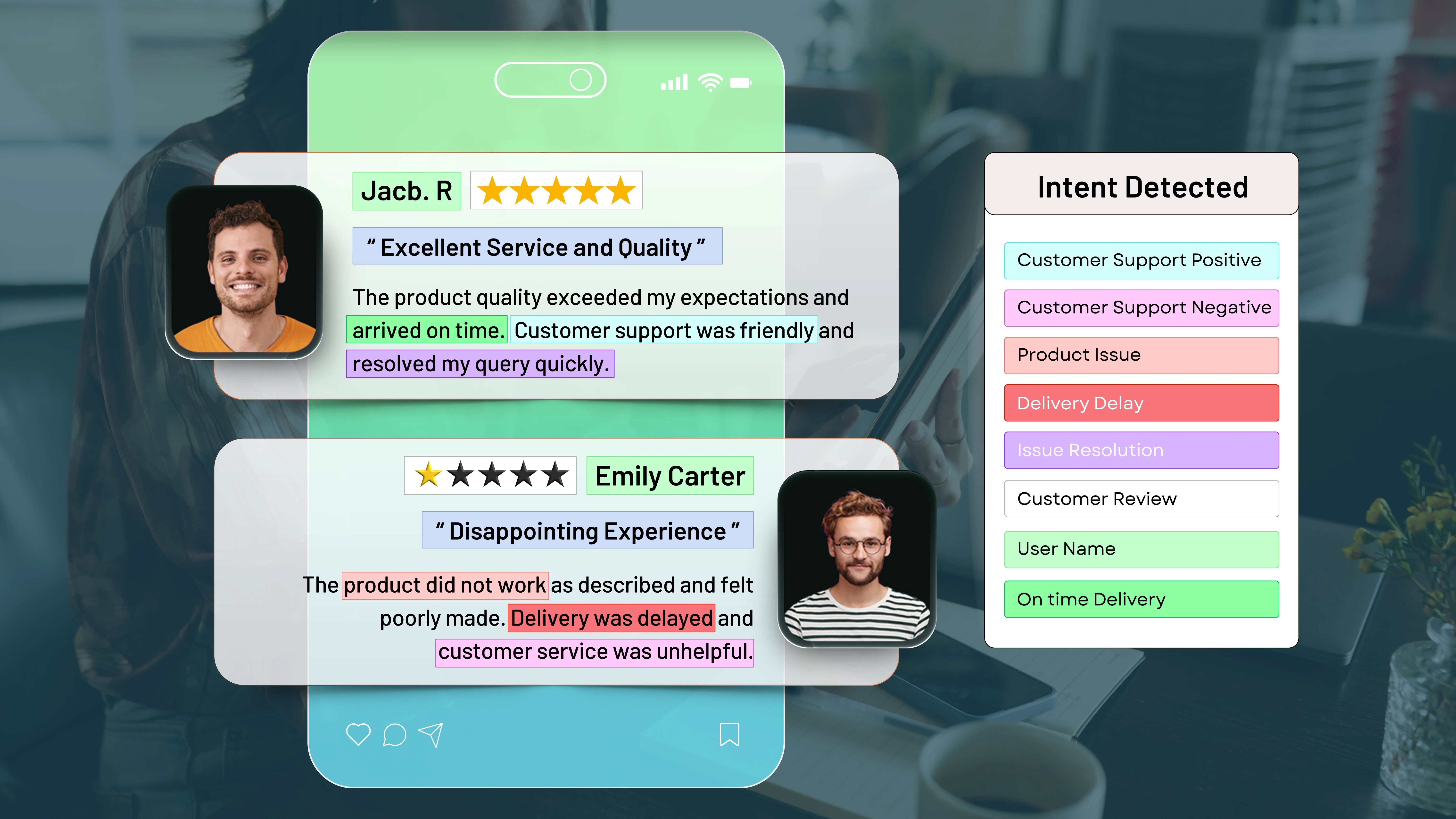
Customer reviews often contain informal language, incomplete context, and overlapping issues. A single review may mention delivery delays, app issues, payment failures, and customer support dissatisfaction in the same paragraph.
The client needed high-throughput labeling with taxonomy discipline - so downstream ML workflows received stable, multi-label outputs rather than noisy single-topic guesses.
- Mixed sentiment within a single review
- Rating alignment with review tone and severity
- Accurate multi-label topic tagging across a wide taxonomy
- Standardized topic selection across 34 annotators
- High volume delivery within 3 days without label drift
What we delivered
Each customer review was annotated with three label types.
Sentiment
- Highly Positive, Positive, Mixed/Neutral, Negative, Highly Negative
Rating (1–5)
A numeric rating assigned based on review tone and severity.
Topic tagging (multi-label classification)
Each review received one or more topic tags depending on the issues mentioned:
- Company, Payment, App/Platform, Discounts/Promotions, Food Quality, Customer Support, Delivery timelines, Wrong Delivery, Missing Items, Security/Fraud, Membership, Other, None of the above
This multi-label approach captured full issue context rather than forcing a single-topic assignment.
Our approach
LabelFort ran the engagement as a single-pass AI workflow: initial predictions for sentiment, rating, and topic tags, followed by annotator validation and standardization against taxonomy definitions.
Step 1
AI pass
Initial sentiment, rating, and topic predictions.
Step 2
Validate
Annotators confirm sentiment and rating alignment.
Step 3
Tag
Multi-label topics verified against taxonomy.
Step 4
Deliver
59,595 structured labels, model-ready.
- AI-assisted workflows generated initial predictions for high throughput across 19,865 reviews.
- Annotators validated sentiment correctness, especially for mixed-tone reviews.
- Rating consistency was checked against review intensity and severity.
- Multi-topic reviews were tagged completely - not reduced to a single category.
- Ambiguous or missing topic classifications were corrected before delivery.
Results
The engagement delivered structured review intelligence labels on schedule - every figure measured on the platform and validated against the client’s taxonomy.
Two reporting notes. The label total counts three decisions per review - Sentiment, Rating, and the Topic set - so a review carrying several topic tags still counts once for topics. Accuracy is checker-phase agreement against the client taxonomy, not an inter-annotator agreement (kappa) score.
- 19,865
- reviews processed
- 92%
- annotation accuracy
- 3 days
- end to end delivery
Sentiment + Rating + Topics per review
Checker-phase field agreement
135 hours 49 minutes of effort
- 19,865 customer reviews processed
- 59,595 structured labels delivered
- 92% annotation accuracy across the validated label set
- 135 hours 49 minutes of total agent effort
- 00:00:25 average handle time per review · 00:00:08 per labeled field
- 34 annotators on an AI-first single-pass workflow with QA validation
Key insights
- Multi-label topic tagging improves downstream model robustness by capturing real-world review complexity.
- Clear taxonomy alignment reduces ambiguity and improves consistency across annotators.
- AI-first workflows significantly increase speed for large review datasets.
- Structured validation is critical to maintain label stability in subjective classification tasks.
Impact
- Sentiment and rating prediction model training
- Multi-topic review categorization and routing
- Product issue mining - payment issues, delivery delays, app platform bugs
- Customer support analytics and escalation systems
- Membership and fraud/security risk detection insights
Key takeaways
- Converted 19,865 reviews into 59,595 structured labels in 3 days at 92% annotation accuracy.
- Multi-label topic tagging captured overlapping issues within single reviews instead of forcing one category.
- AI-first single-pass annotation with QA validation balanced throughput and label stability at scale.
- Taxonomy-aligned validation kept 34 annotators consistent across informal, mixed-tone customer language.
More case studies
Media & publishing Trust & safety
 E-commerce & consumer
Want labels your auditors can read?
Start with a one hour Compliance Review on your own data.
Certifications & readiness