Data provenance
The origin story
Where data came from, who collected it, under what consent or license, and how it was handled. Answers: were we allowed to use it this way?
A practical, step-by-step guide to auditing AI systems for compliance, plus a data-provenance checklist covering origin and rights, labeling, lineage, evidence retention, and separation of duties.

Ankit Goyanka
· 5 min read
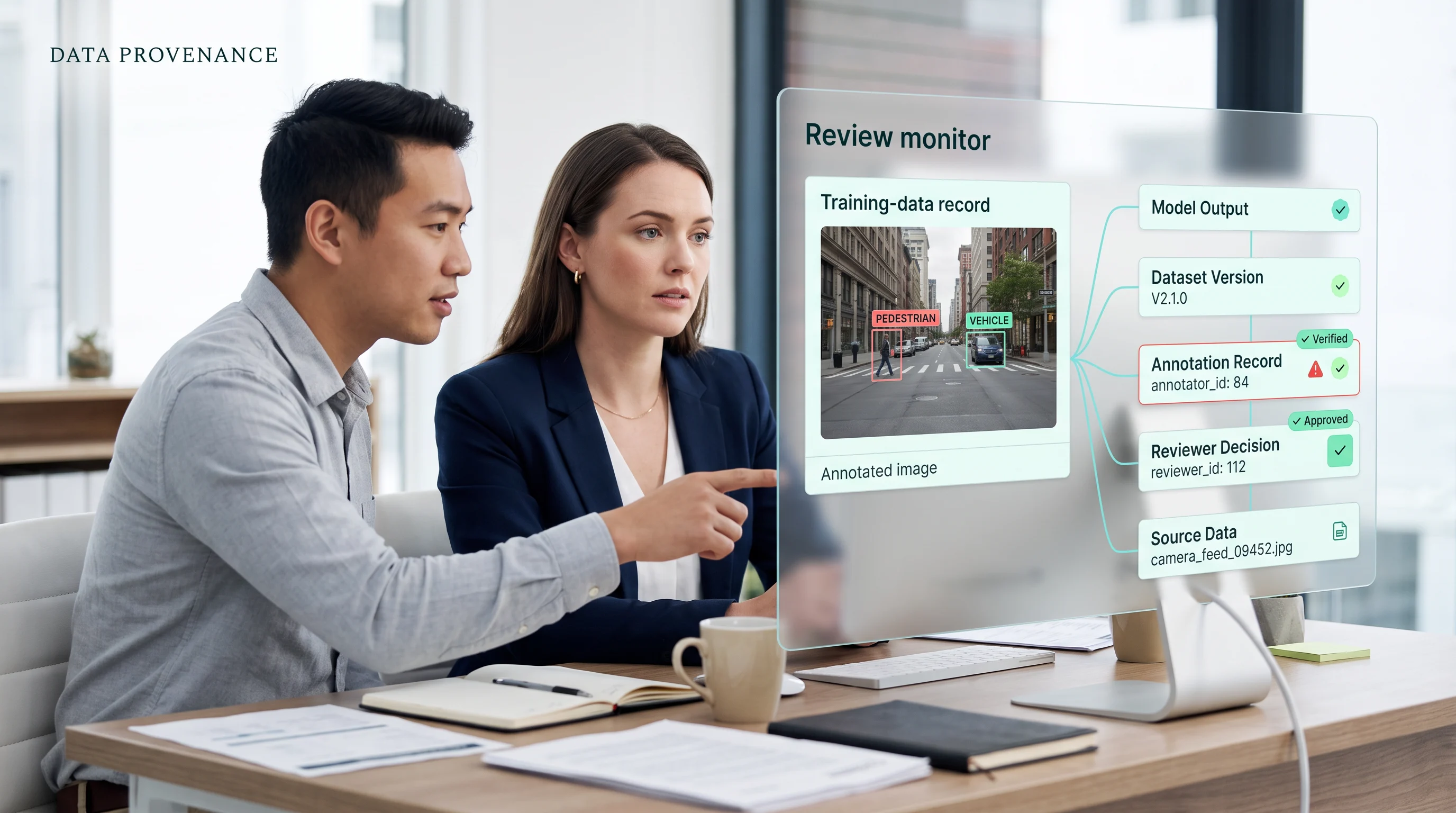
This piece covers how to audit AI systems for compliance, then gives you a data-provenance checklist to run against your own pipeline before anyone else does.
An AI audit is a systematic review of whether a system meets the standards that apply to it. It borrows from traditional auditing: define a scope, gather evidence, test against criteria, document findings, and remediate. Most credible frameworks converge on a similar sequence:
Step 1
Which systems, models, or pipelines are under review - production models, prototypes nearing deployment, and any third-party models you've integrated?
Step 2
Document the full path from data collection and model design through deployment and post-market monitoring.
Step 3
Examine sourcing, provenance, quality, and labeling - including the right to use it. This is where audits often find gaps.
Step 4
Accuracy, robustness, explainability, and bias against relevant fairness metrics.
Step 5
Map the system against the specific regulations that apply, using tailored checklists where they exist.
Step 6
Produce a report with issues, supporting evidence, and an action plan with owners and timelines.
Notice how early the data shows up - step three of six. You cannot assess bias without knowing how the data was labeled or prove the right to use data without provenance. The data layer isn’t one topic among many; it’s the foundation on which the others stand.
Two terms get used interchangeably and shouldn’t be, because an auditor will expect both.
Data provenance
Where data came from, who collected it, under what consent or license, and how it was handled. Answers: were we allowed to use it this way?
Data lineage
The path through transformations, filters, and merges from raw source to training dataset. Answers: what happened along the way, and can we trace any output back?
Together, they establish a chain of custody: the unbroken, documented record that lets you stand behind a dataset under scrutiny.
Run this against each dataset that feeds a model in scope. If you can’t answer “yes, and here’s the evidence” to an item, that’s a finding better discovered by you now than by an auditor later.
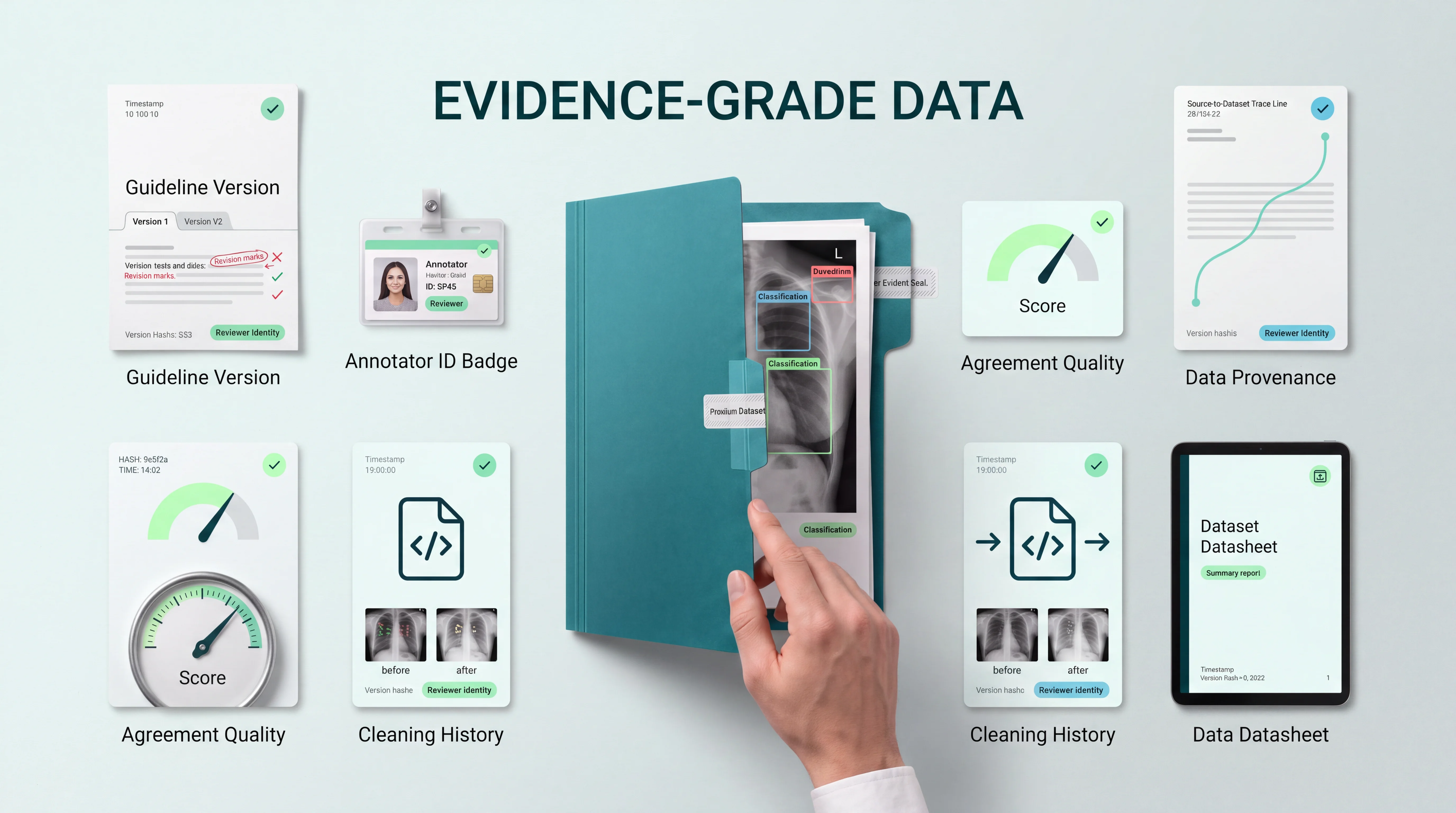
For the six-artifact standard regulators expect at labeling time, see evidence-grade annotation.
This is the problem LabelFort was built to solve at the source - so the checklist above is satisfied by default rather than retrofitted under a deadline.
The same sequence as any audit, applied to a model: define the scope, map the AI lifecycle, assess the data, evaluate the model, check against the regulations that apply, then document findings and remediate. Data sits at step three of six - you cannot assess bias without knowing how the data was labeled.
Provenance is the origin story - where data came from, who collected it, under what consent or license. It answers whether you were allowed to use it this way. Lineage is the journey - the path through transformations, filters, and merges from raw source to training dataset. Auditors expect both; together they form a chain of custody.
The labeling section. Origin and rights are usually documented somewhere, but a per-record account of who annotated what, against which guideline version, and how annotator disagreements were resolved is rarely captured - and cannot be reconstructed afterwards.
It is the defensible metric to report, but a single cohort-level number is not the whole answer. An auditor will also ask how disagreements were adjudicated and by whom, so the score needs the adjudication record behind it.
A log that can be quietly edited proves nothing about what happened. Tamper-evidence is what turns a record into evidence, which is why the checklist asks whether labeling actions are logged automatically as they happen rather than compiled later.
Long enough to satisfy both the applicable regulation and the model's own lifecycle - whichever runs longer. A model in production past its dataset's retention window leaves you unable to answer questions about data you are still relying on.
That is the point of it. Run it per dataset that feeds a model in scope. Any item you cannot answer with "yes, and here is the evidence" is a finding - better found by you now than by an auditor later.
Every labeling action, reviewer decision, and dataset change is captured in a tamper-evident audit trail as it happens. Chain of custody exports in formats auditors already accept. To be precise about scope: this governs the training-data layer of your audit - the part with the longest lead time, and where audits most often stall.
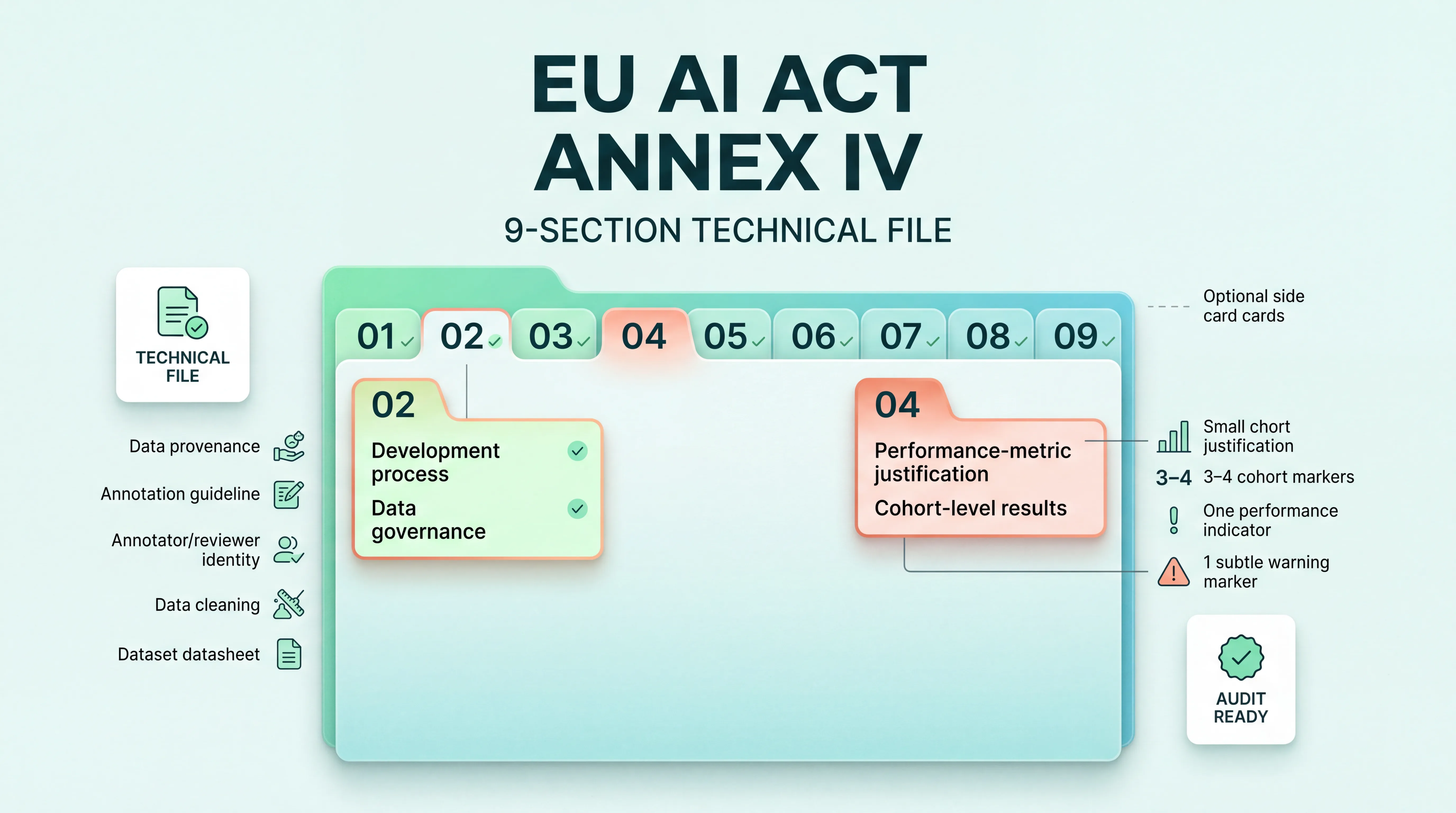 EU AI Act
 EU AI Act
 Annotation
IAA scored per cohort, audit trails on every action, evidence exports mapped to EU AI Act Articles 10 & 12.
Certifications & readiness