High-quality annotation
Label accuracy
Describes whether the labels are correct. Important - but independent of whether you can prove how they were produced.
Evidence-grade annotation is the audit-ready standard for AI training data. Six artifacts captured at labeling time meet EU AI Act, HIPAA, and AI compliance demands.

Ankit Goyanka
· 5 min read
Executive summary
Evidence-grade annotation is data annotation where every artifact required to defend the dataset under audit is produced at the moment of labeling, versioned, and exportable as a per-dataset evidence bundle alongside the labels themselves.
Each clause does specific work:
High-quality annotation
Describes whether the labels are correct. Important - but independent of whether you can prove how they were produced.
Evidence-grade annotation
Can you prove how labels were produced, by whom, under which guideline version, and against which audit-trail control?
A dataset can be labeled correctly and still fail Annex IV Section 2 if the labeling procedure cannot be evidenced. Quality and defensibility are independent.
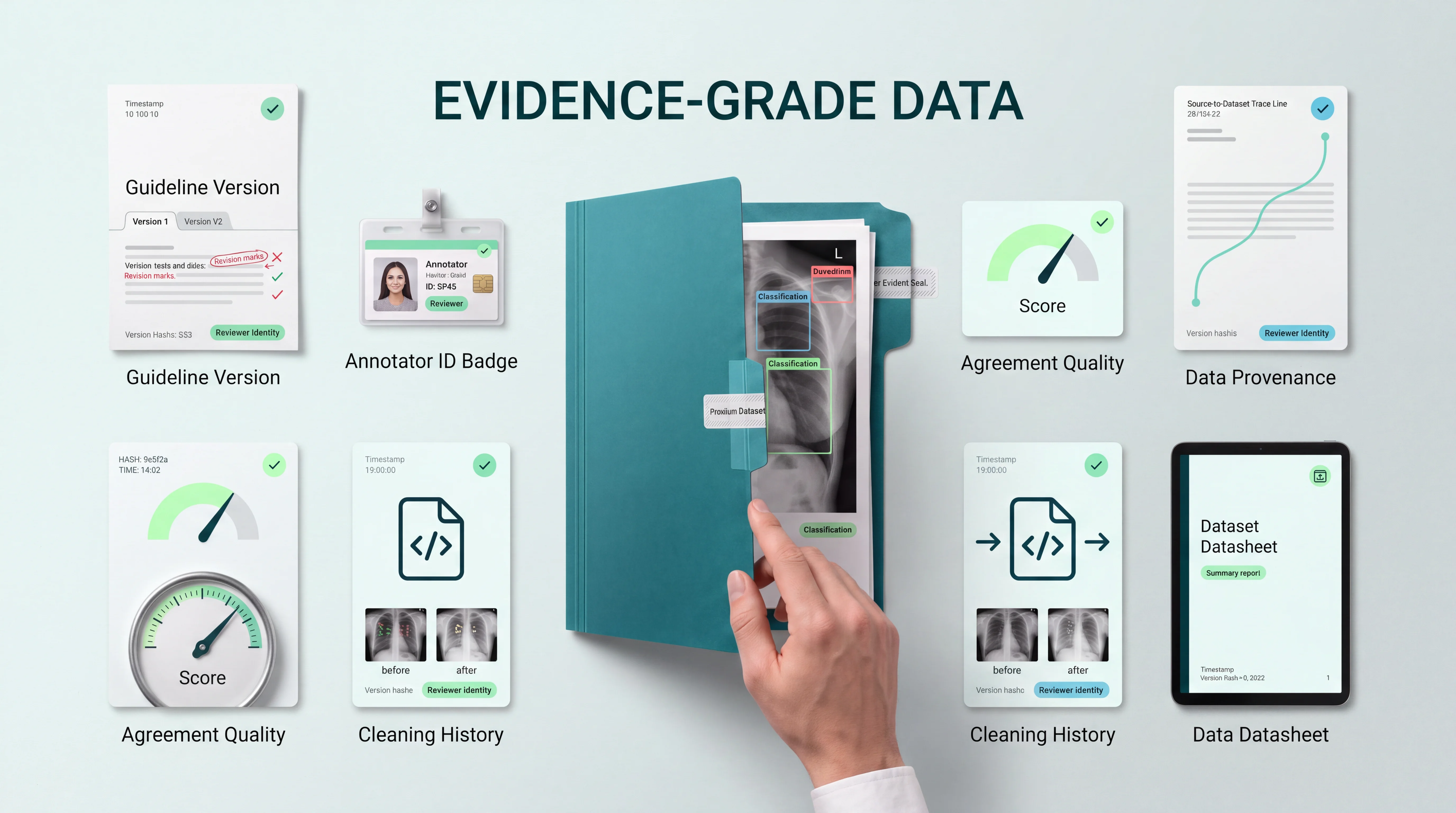
The exact instruction set used to label each record, with a version hash. Maps to: EU AI Act Annex IV Section 2; ISO/IEC 42001 Annex A.6.2.
For every record: who labeled it, when, with what qualification, and - if reviewed - who reviewed it. Maps to: HIPAA Section 164.502; EU AI Act Annex IV Section 2.
Cohen’s κ or Krippendorff’s α, broken down by the cohorts the model’s Section 3/4 will need to evidence. Maps to: EU AI Act Annex IV Section 4; ISO/IEC 42001 Annex A.6.2.
Where the data came from, how it was selected, how it crossed borders, and a deduplication record. Maps to: EU AI Act Annex IV Section 2; GDPR Article 28; DPDP Sections 8–10; SOC 2 CC7.
Outlier-detection, de-duplication, and missing-value handling - applied as code, not “common sense.” Maps to: EU AI Act Annex IV Section 2; ISO/IEC 42001 Annex A.6.2.
A single per-dataset document following the Gebru et al (2018) framework - auto-populated from the underlying log. Maps to: EU AI Act Annex IV Section 2; ISO/IEC 42001 Annex A.6.2; NIST AI RMF.
When all six are captured at annotation time and exported together, the dataset is evidence-grade. When any one is missing, the gap costs more to remediate than the labels did to produce.
Each regime asks for a different subset of the six, but the union of their demands is exactly the six. Build for the union and you pass each individual audit.
| Regime | What it asks for | Effective date |
|---|---|---|
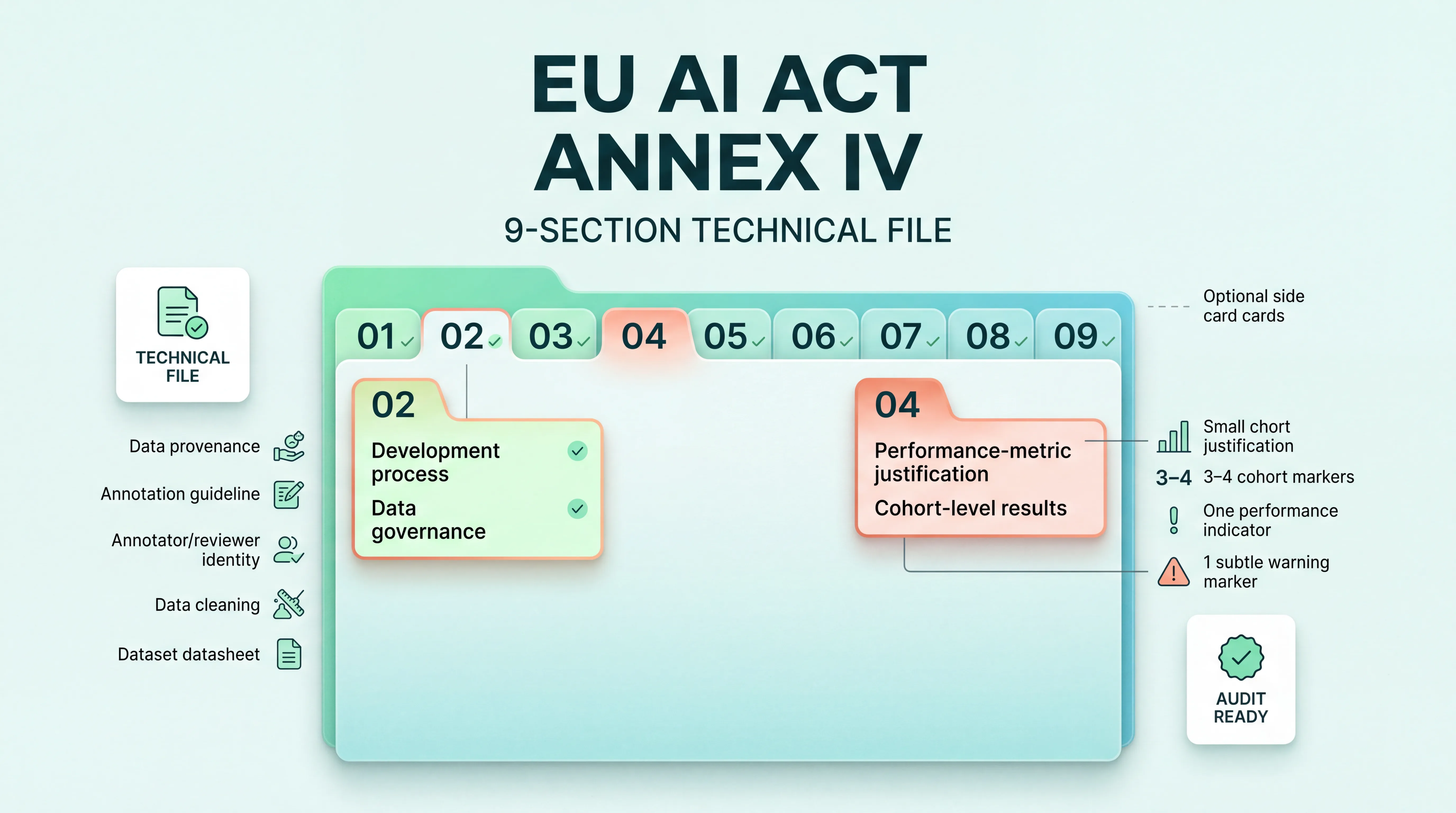
| EU AI Act Annex IV (Article 11) | All six. Section 2 calls out labeling procedures, datasheets, cleaning methodologies, provenance. Section 4 calls out cohort-level performance evidence. | 2 December 2027 (Annex III; Digital Omnibus) |
| HIPAA Section 164.502 + 164.312 | Audit-trail (#2), provenance (#4), minimum-necessary access controls. Plus role separation enforced inside the annotation tool. | In force |
| SOC 2 Trust Services Criteria | CC7 (change management) requires evidence of dataset changes; CC9 (risk mitigation) requires the provenance log; CC8 requires the transfer log. | In force |
| ISO/IEC 42001:2023 Annex A.6 | Data quality and integrity controls. A.6.2.4 explicitly: documented labeling procedures, IAA records, datasheet, provenance, cleaning. | Published October 2023 |
Training-data production where every artifact a regulator or auditor will ask for is captured at the moment of labeling and exportable as a per-dataset evidence bundle.
High quality describes label accuracy. Evidence-grade describes audit-defensibility of the labeling process. They are independent axes.
Three of the six artifacts decay irrecoverably at the moment the annotation tool moves to the next batch. Reconstruction is forensic re-annotation, not documentation.
EU AI Act Article 11 Annex IV Section 2, HIPAA Section 164.502, SOC 2 CC7, and ISO/IEC 42001:2023 Annex A.6 - together they define the 2026 baseline.
No. Necessary but not sufficient. Ask specifically whether the tool captures the six artifacts at annotation time.
On the headline per-label rate, marginally - typically 10–25% higher. On the risk-adjusted TCO, it's lower. See the outsourcing guide for the full model.
 EU AI Act
 Audit
Audit Outsourcing
IAA scored per cohort, audit trails on every action, evidence exports mapped to EU AI Act Articles 10 & 12.
Certifications & readiness