Cost-per-label vendor
Low headline TCO
Fast ramp, low per-label rate - but evidence must be reconstructed after delivery. Risk-adjusted TCO is often higher than in-house once remediation is priced.
Data annotation outsourcing in 2026 isn't a cost-per-label decision - it's an evidence problem. A 12-criterion vendor scorecard plus a TCO and risk calculator.

Ankit Goyanka
· 5 min read
Executive summary
If you are running an annotation budget in 2026, the calculus has shifted. Almost none of the published vendor guides includes the cost of evidence that doesn’t exist when an auditor asks for it. That is the gap this article fills.
Three forces converged over the last twelve months. Any vendor pitch you read that doesn’t address all three is selling you the 2024 model of annotation outsourcing.
Force 1
2024–2026
Vendor neutrality became a procurement gate after the Meta–Scale AI arrangement.
Force 2
Dec 2027
EU AI Act Article 12 makes tamper-resistant logging statutory for high-risk AI.
Force 3
Now
AI-assisted pre-labeling is table stakes - and auto-labels without human verification are the top new failure mode.
Most existing outsourcing guides reduce the decision to a 3-by-3 grid on cost, speed, and quality. That grid is correct as far as it goes - and incomplete. The regulated-AI buyer ships the dataset plus the evidence that the dataset was produced defensibly.
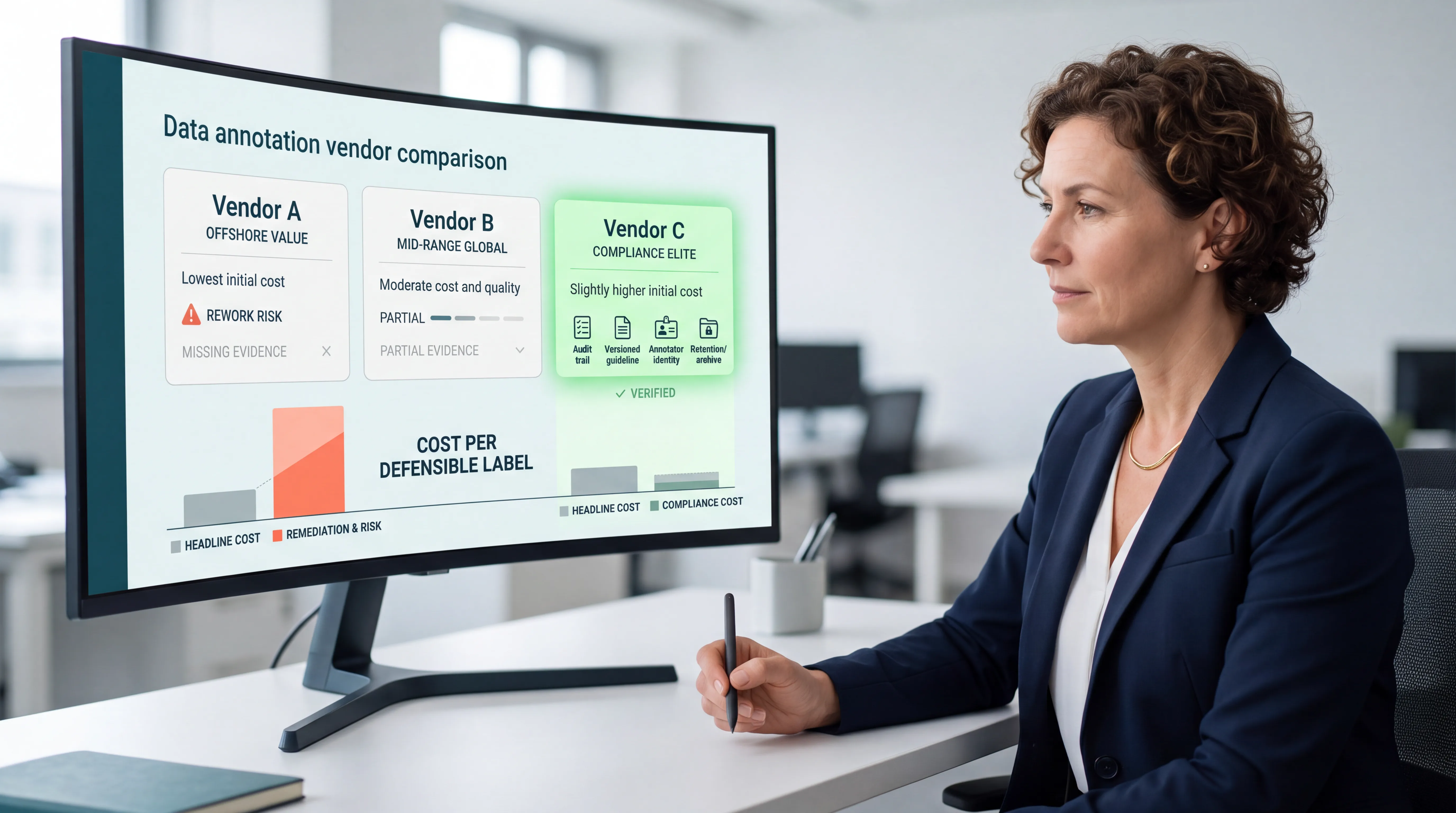
Cost-per-label vendor
Fast ramp, low per-label rate - but evidence must be reconstructed after delivery. Risk-adjusted TCO is often higher than in-house once remediation is priced.
Evidence-grade vendor
Evidence captured at annotation time - guideline versioning, cohort IRR, provenance log, cleaning code. Lowest risk-adjusted TCO.
A 100,000-image diabetic-retinopathy screening dataset for a Series-B health-tech going to market in the EU under Annex III.
| Line item | In-house | Cost-per-label vendor | Evidence-grade vendor |
|---|---|---|---|
| Specialist labour (100K × $1.50) | $225,000 | $150,000 | $150,000 |
| Per-cohort IRR (6 cohorts) | $20,000 | impossible to reconstruct | $0 default |
| Evidence retention (7-yr SaMD) | $35,000 | +$35K recreate cost | $7,000 |
| Headline TCO | $335,000 | $175,000 | $155,000 |
| Risk-adjusted TCO (r = 0.9) | $390,000 | $310,000 | $162,000 |
| Evidence Defensibility Score | 95 | 35 | 100 |
The cost-per-label vendor looks cheapest on the PO. It is the most expensive on the risk-adjusted line.
Score each 0/1/2 (absent / partial / verified). Total of 24. Below 18 means the vendor cannot meet 2026 regulated-AI procurement.
| # | Criterion | What to look for |
|---|---|---|
| 1 | ISO/IEC 27001:2023 | Active certification, not “aligned.” |
| 2 | SOC 2 Type II report | Report dated within 12 months. |
| 3 | HIPAA-aligned controls | BAA template available. |
| 4 | GDPR + DPDP readiness | DPA + DPDP control mapping pre-PoC. |
| 5 | Role separation by configuration | Annotator / reviewer / auditor distinct. |
| 6 | Immutable audit trail | Per-action log exportable. |
| 7 | IAA capture per record | Cohen’s κ and/or Krippendorff’s α, by cohort. |
| 8 | Versioned annotator guidelines | Guideline version hash on every record. |
| 9 | Vendor neutrality | No foundation-lab or hyperscaler equity stake. |
| 10 | Data residency options | EU-only, India-only, or US-only as required. |
| 11 | Evidence export format | Per-dataset evidence bundle in documented format. |
| 12 | Post-engagement retention | Retention period matching AI-system lifecycle. |
Basic image bounding boxes run $0.02–$0.10 per image; medical labels $1.00–$5.00+; audio $0.50–$3.00 per minute. Hourly: $6–$12 standard, $50–$100 medical specialist.
At project volumes under 50K labels per month, outsourcing is almost always cheaper on headline TCO - typically 3–7× lower than building internal capacity.
Use the 12-criterion scorecard. Most buyers underweight role separation, IAA per-record capture, vendor neutrality, and post-engagement retention.
Vendor neutrality became a procurement criterion. EU AI Act Article 12 made tamper-resistant logging statutory. AI-assisted pre-labeling became table stakes.
Only if the vendor captures evidence at annotation time. See our Annex IV article for the full sub-clause map.
Compliance Review → evidence-grade PoC → governed pilot → procurement-ready scale. Pilot-to-production typically runs 30–45 days.
 EU AI Act
 Audit
Audit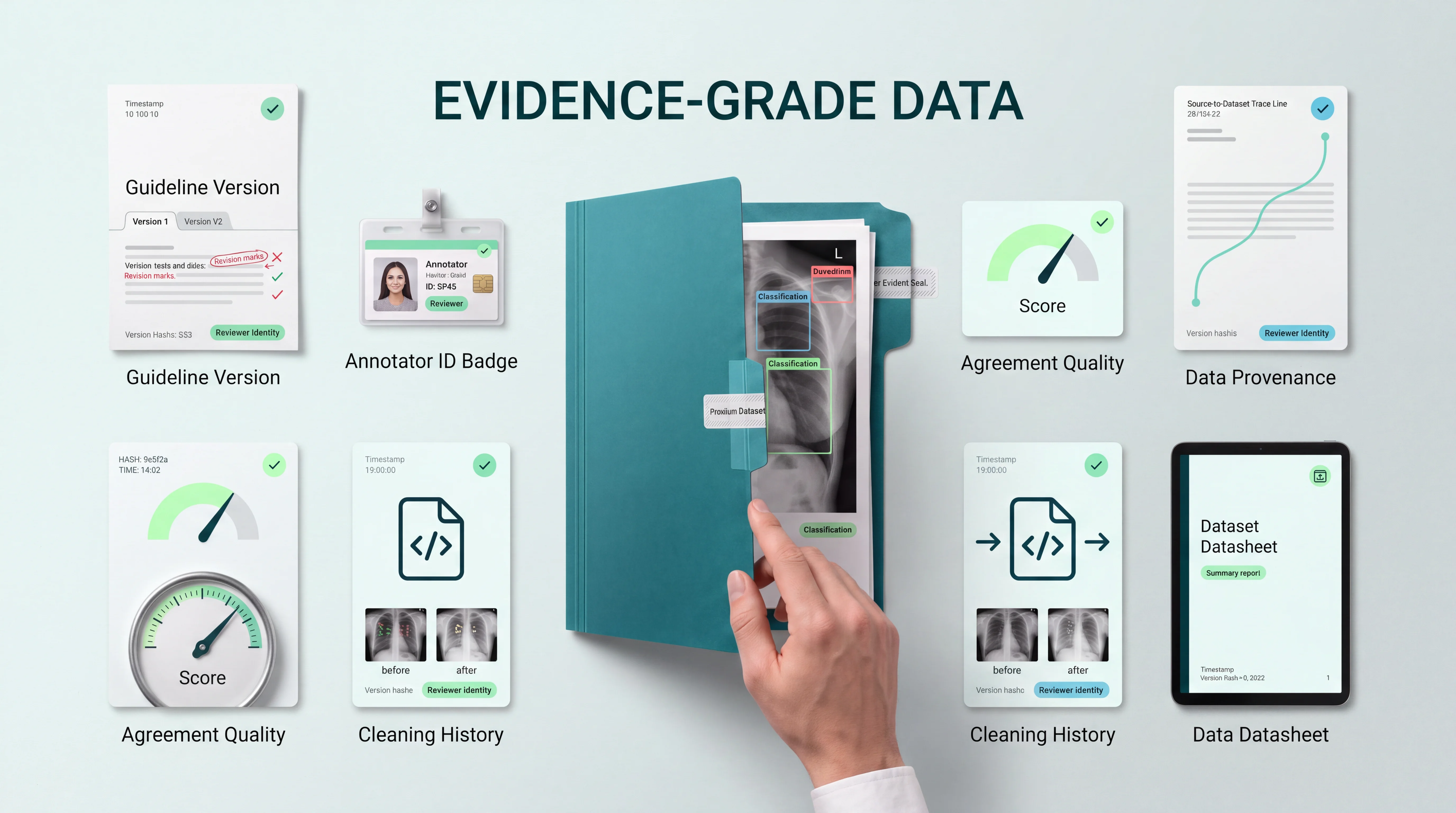 Annotation
IAA scored per cohort, audit trails on every action, evidence exports mapped to EU AI Act Articles 10 & 12.
Certifications & readiness