
 Media & publishing
90% accuracy in 2 days: how LabelFort classified 1,087 sentences across genre and sub-genre
How LabelFort delivered a QA-based text classification dataset with two labels per sentence - Genre and Sub-Genre - using a maker-checker workflow across 31 annotators in a 2-day window.
- Media & publishing
- Text · genre & sub-genre classification
Contents
The client builds content understanding and categorization systems that route, recommend, and index multi-domain text at scale. Their models depend on consistent two-level classification - separating sentence intent (Genre) from topic detail (Sub-Genre) - so overlapping writing styles do not collapse into ambiguous training signal.
LabelFort ran a QA-based text classification engagement across 1,087 sentences, producing 2,061 validated Genre and Sub-Genre labels within 2 days. A maker-checker workflow held 31 annotators to one taxonomy, with checker review on every label before delivery.
The challenge
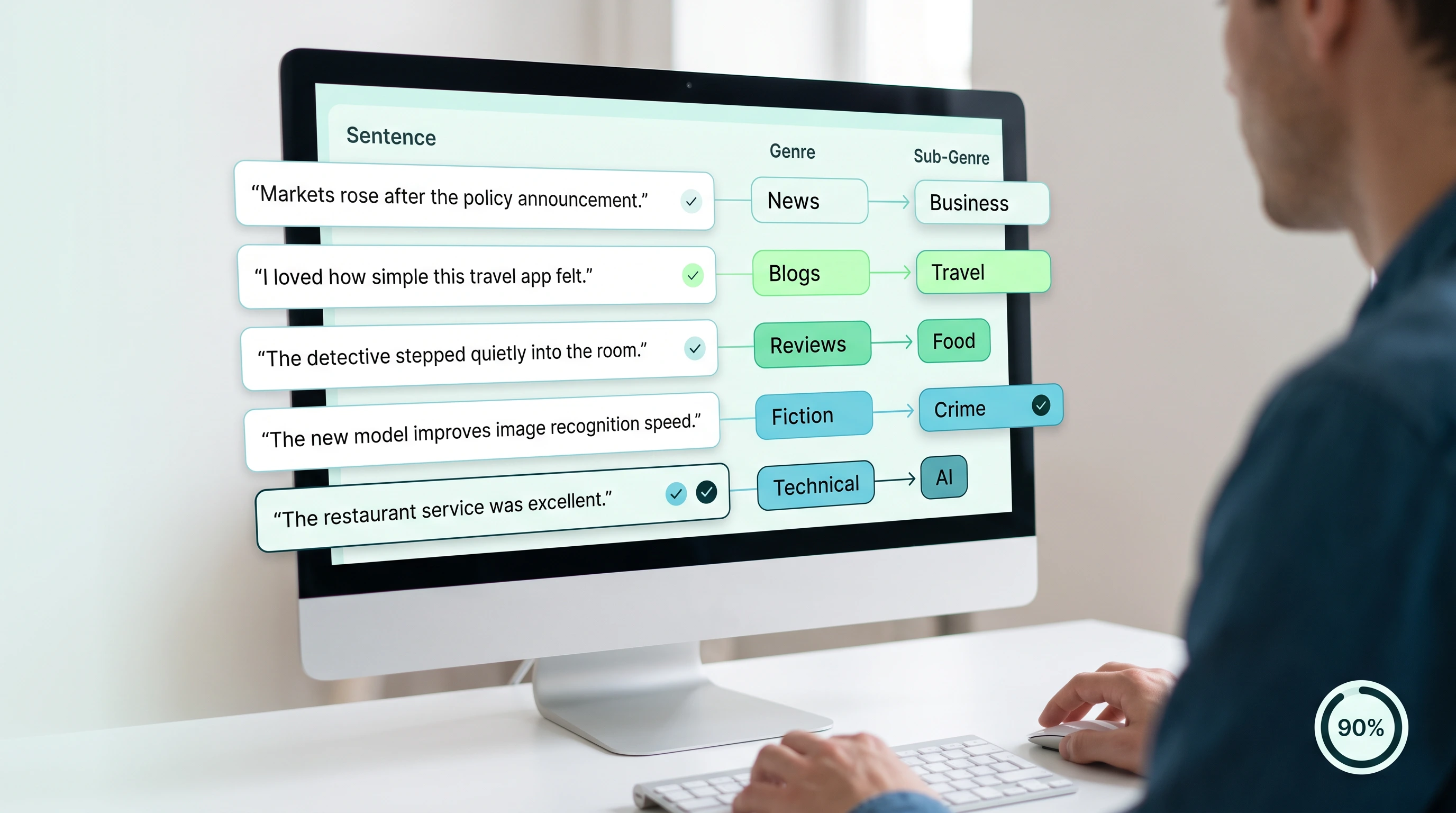
Genre and sub-genre classification requires consistent human interpretation because many sentences overlap in style and meaning. Factual content may appear inside blogs, reviews may resemble opinion pieces, and technical topics may appear within news formats.
The client needed taxonomy-aligned labels at speed - without letting subjective drift accumulate across a large annotator pool.
- Accurate Genre selection based on sentence intent and writing style.
- Correct Sub-Genre assignment based on topic context and domain definitions.
- High consistency across 31 annotators to reduce ambiguity and label drift.
- Delivery within 2 days without compromising classification reliability.
What we delivered
Each sentence received two labels.
Genre (category) was selected based on sentence intent and tone:
- News - factual, real-world reporting
- Blogs - personal, reflective, opinionated, experience-driven
- Reviews - evaluation, rating, critique, comparison
- Fiction - imaginative narrative, storytelling
- Technical - tools, AI, software, engineering, technology concepts
Sub-Genre (sub-category) was assigned as a topic-level classification under each genre. Examples include Politics, Business/Economy, Technology, Sports, Entertainment, Health/Medical, Lifestyle, Crime & Law, Nature/Environment, Opinion (blog-specific), and review-specific sub-genres for apps, travel, food, services, and professional reviews.
This two-level framework represented both sentence intent and topic/domain detail in every record.
Our approach
LabelFort ran the engagement as a maker-checker workflow: annotators applied the taxonomy under shared guidelines, and checkers validated every label before it shipped.
Step 1
Maker
Annotator assigns Genre and Sub-Genre per sentence.
Step 2
Checker
QA validates genre correctness and sub-genre alignment.
Step 3
Standardize
Ambiguous cases resolved against definitions.
Step 4
Deliver
2,061 validated labels, model-ready.
- Genre selection followed intent and tone rules; Sub-Genre followed domain definitions.
- Checkers verified genre correctness, sub-genre alignment, and corrected misclassifications.
- Ambiguous cases were standardized so subjective noise did not compound across annotators.
- Every label passed checker review - not a sample - before delivery.
Results
The engagement delivered taxonomy-aligned classification labels on schedule - every figure measured on the platform and held to the client’s QA standard.
Two reporting notes. The label total is counted output, which is why 2,061 sits below 1,087 × 2 - not every sentence resolved to a valid sub-genre under the taxonomy. Accuracy is checker-phase agreement against the taxonomy definitions, not an inter-annotator agreement (kappa) score.
- 1,087
- sentences annotated
- 90%
- annotation accuracy
- 2 days
- end to end delivery
Genre + Sub-Genre per sentence
Checker-phase field agreement
83 hours 36 minutes of effort
- 1,087 sentences annotated
- 2,061 Genre and Sub-Genre labels delivered
- 90% annotation accuracy across the validated label set
- 83 hours 36 minutes of total agent effort
- 00:04:37 average handle time per sentence · 00:02:26 per labeled field
- 31 annotators on a maker-checker workflow
Key insights
- Two-level labeling strengthens training signals by separating intent from topic.
- Clear intent-based genre rules reduce confusion across overlapping writing styles.
- Maker-checker QA significantly improves consistency for subjective classification tasks.
- Structured sub-genre definitions enable scalable indexing and analytics across multi-domain content.
Impact
- Content categorization and routing systems
- Recommendation and personalization engines
- Topic clustering and indexing for blogs, news, and reviews
- Model training for multi-domain genre classification
- Review mining and content analytics pipelines
Key takeaways
- Delivered 2,061 validated labels across 1,087 sentences in 2 days at 90% annotation accuracy.
- A maker-checker model put checker validation on every label, holding 31 annotators to one taxonomy.
- Genre and Sub-Genre labeling separated sentence intent from topic detail for stronger downstream training signal.
- Structured sub-genre definitions kept subjective boundaries consistent across overlapping writing styles.
More case studies
Media & publishing E-commerce & consumer
 Trust & safety
Want labels your auditors can read?
Start with a one hour Compliance Review on your own data.
Certifications & readiness